
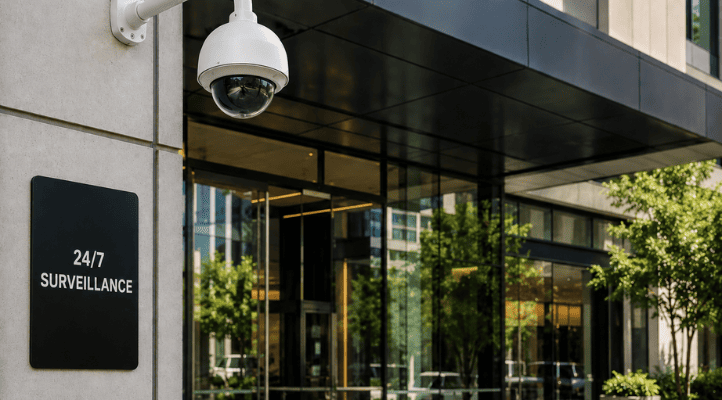
Physical and digital security are no longer separate conversations. For Australian organisations managing real assets and real risks, understanding how your built environment affects your cyber exposure is no longer optional – it’s essential.
Why CPTED and Cyber Security Belong Together
Traditionally, CPTED focuses on designing environments to deter crime by influencing human behaviour and increasing natural surveillance, access control and territorial reinforcement. Today, cyber threats exploit weaknesses in both digital and physical environments.
For example, insecure data centres, unmanned comms rooms and poorly protected access points can become gateways for cyber intrusions. By merging CPTED assessment techniques with cyber security best practices, organisations can identify where physical design choices affect cyber risk, and vice versa.
The result is a more resilient security framework built on the synergy of environmental design and digital protection. This approach relies on security risk assessments to quantify threats, vulnerabilities and impacts, while CPTED assessment helps visualise how space, processes and technology interact.
Where Physical and Cyber Threats Overlap
Australian businesses increasingly operate in hybrid environments – on-premises infrastructure alongside cloud systems, remote workers, and third-party contractors. This creates a layered threat landscape where:
- A compromised access badge can expose your server room
- Poor visitor management enables insider threats
- Unsecured cabling and network points allow device tampering
- Blind spots in surveillance create undetected intrusion opportunities
A proper CPTED assessment maps these physical conditions to their cyber consequences, giving security teams a clear picture of where environmental design is leaving the organisation exposed.
How to Conduct a CPTED – Informed Security Risk Assessment
A security risk assessment that incorporates CPTED thinking goes beyond scanning for software vulnerabilities. It asks: What does your physical space enable an attacker to do?
Here’s a practical framework:
1. Map Your Critical Assets
Identify data centres, server rooms, network cabinets, UPS systems, and IT support hubs. Note their locations relative to public access areas, entry points, and staff activity.
2. Assess Natural Surveillance
- Can staff observe unauthorised access to IT zones?
- Are there blind spots around server rooms or comms cabinets?
- Is CCTV coverage adequate and monitored?
3. Evaluate Access Control
- Who has physical access to sensitive areas – and is it regularly reviewed?
- Are tailgating risks managed at entry points?
- Do digital access privileges align with physical access rights?
4. Apply Territorial Reinforcement
- Are physical boundaries clearly marked?
- Do staff and contractors understand which areas are restricted?
- Is signage consistent with your security policies?
5. Build a Unified Risk Register
Map physical vulnerabilities directly to cyber risk categories: confidentiality, integrity, and availability. Each physical finding should link to a cyber consequence and a mitigation owner.
Example: an unlocked comms cabinet in a shared corridor is a risk of a network tap or rogue device insertion and a threat to data confidentiality and network integrity.
The CPTED Cyber Security Framework in Practice
Applying CPTED to cyber security means turning design principles into concrete controls:
- Natural surveillance for cyber assets: place important devices in well-lit, monitored locations; use cameras and visitor screens to deter tampering with IT spaces.
- Access control and visitor management: implement strict authentication for areas housing servers and network equipment; require escorting for contractors; enforce temporary access revocation.
- Territorial reinforcement in digital terms: clearly delineate responsibility for specific zones, such as data zones and industrial control spaces; use physical indicators and digital access policies to reinforce boundaries.
- Activity support (space management): monitor and document the flow of people and goods in sensitive areas; implement remote telemetry and anomaly detection for critical equipment.
As part of security risk assessments, consider hypothetical scenarios: a stolen badge, a rogue contractor, or a misconfigured network port. Evaluate how swiftly controls respond and whether business processes can compensate for any gaps.
This is where business continuity plans intersect with CPTED cyber security: your resilience depends on how rapidly you can detect, respond, and recover from incidents that begin in physical space or extend into digital networks.
Aligning with Business Continuity Plans
Most Australian organisations have business continuity plans that address IT system failure, data loss or cyber incidents. Few account for how a physical security failure can trigger a cyber incident in the first place.
A CPTED-informed approach helps ensure continuity by:
- Aligning critical asset inventories with recovery objectives: identify which assets require rapid restoration and ensure their physical protection aligns with recovery priorities.
- Enhancing incident response coordination: integrate facilities teams, IT security, and Security Operations Centres (SOCs) for unified response.
- Cross-training staff: educate employees about security hygiene both online and offline, including proper handling of sensitive equipment and data.
- Practising with tabletop exercises: simulate combined physical-cyber incidents (for example, a power outage affecting data centre cooling and network resilience) to test detection, containment, and recovery capabilities.
- Ensuring redundancy and resilience: diversified power supplies, secure server rooms and geo-redundant data backups minimise single points of failure.
These elements ensure that security risk assessments inform BCPs and that CPTED assessment outcomes feed into business continuity planning. In this way, the organisation creates a layered, resilient posture that mitigates both physical and cyber threats.
Practical Implementation Steps for Australian Organisations
Getting started doesn’t require a complete security overhaul. Here’s what to prioritise:
- Get leadership alignment: articulate the value of integrating CPTED strategies into cyber risk management to executives and facilities teams.
- Form a cross-functional team: security, facilities, IT, HR, and legal to ensure comprehensive coverage.
- Develop a unified risk register: capture both physical security and cyber security risks, with joint mitigation owners and timelines.
- Prioritise quick wins: enhance access controls around critical assets, install tamper-evident seals on cabinets, and improve visitor management in sensitive areas.
- Invest in training and awareness: educate staff about security best practices in both physical and digital contexts.
- Regularly review and update: conduct quarterly or biannual reviews of CPTED-informed risk assessments and adjust BCPs as threats evolve.
By following these steps, Australian organisations can implement a practical CPTED assessment approach that strengthens security risk assessments and enhances overall cyber resilience.
Final Thoughts
Physical and cyber threats don’t operate in silos, and neither should your security strategy. Whether you’re reviewing an existing security risk assessment, updating your business continuity plans, or starting a CPTED assessment from scratch, getting the right expertise in your corner makes all the difference.
Ready to strengthen your cyber security through smarter environmental design? For professional guidance on CPTED cyber security and security risk assessments for your public or commercial property, reach out to us today or call (02) 9191 9771 to schedule a consultation with our team.