
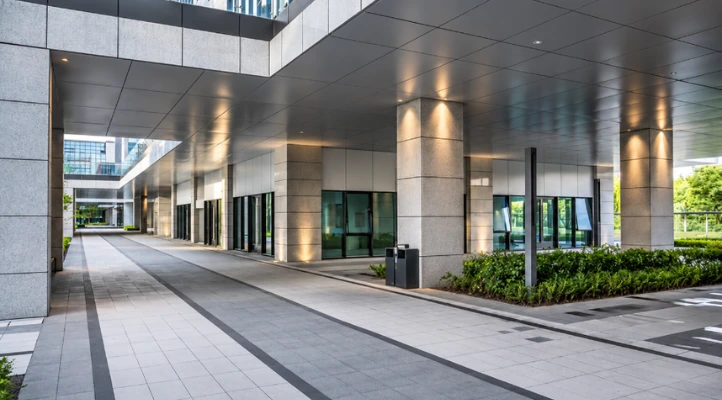
A security risk assessment for a commercial building change of use checks whether the existing physical security still suits the way the building will now be used, occupied and accessed.
When an office becomes a clinic, a warehouse opens to customers or a single tenancy splits into several, the old access arrangements can leave gaps that the previous use never exposed. Reviewing those gaps before fit-out or reoccupation helps owners identify unsuitable access arrangements and avoid unnecessary security upgrades.
An assessment is not a universal requirement for a change of use, although a consent authority, lease or project brief may ask for one. Owners also commission assessments voluntarily to support informed property decisions.
What Security Risks Can a Commercial Change of Use Create?
A change of use can create security risks because the people, activities and access routes change while the building’s security measures stay the same. These are common change of use scenarios, and the appropriate design response often involves access arrangements rather than additional equipment.
| Change of use scenario | Potential vulnerability | Design consideration |
| Office to medical centre | Public access near staff-only or sensitive areas | Review reception position and access restriction |
| Warehouse to customer-facing premises | Loading access overlaps with visitor entry | Separate public entrances from servicing areas |
| Single tenancy to multiple tenancies | Shared corridors provide access to previously restricted areas | Review tenancy boundaries and internal access controls |
| Office to education or training | Different visitor access and room security needs | Review entrances, circulation and restricted rooms |
| Daytime to extended hours | Lighting, surveillance and entry controls may not suit evenings | Review external lighting, surveillance and after-hours access |
These are illustrative scenarios. The actual risks depend on the building’s configuration, proposed use and security controls already installed.
How Does a Change of Use Affect Building Access and Security?
A change of use affects security mainly by changing who can reach which parts of the building and when. Three areas deserve particular attention.
Public entrances and reception areas
A building designed for employees may not work as a public-facing business. We check whether visitors can reach the intended public areas without passing through staff spaces, service corridors or other restricted locations.
That means reviewing reception positioning, door access controls, internal circulation and visibility around entrances. It also means making sure the boundary between public and private spaces is clear to visitors, which reflects the CPTED principle of Territorial Reinforcement.
Shared tenancies and internal boundaries
Splitting a tenancy into several occupancies creates new security risks around shared entrances, corridors, storage rooms and service areas. A previously restricted internal door may become accessible to unrelated tenants and their visitors.
We assess whether physical separation and access permissions remain appropriate for the new tenancy arrangements.
Loading areas and after-hours access
Commercial building conversions can change how vehicles, staff and visitors access a property. Existing loading docks, service doors and rear entrances can become unintended access routes once the premises are more open to the public.
Where operating hours change, we also check whether lighting, surveillance and entry controls remain suitable. Our guide to security risk assessments for industrial sites covers security considerations for industrial premises in more detail.
The priority is to identify weaknesses created by the new use, not replace security systems simply because a refurbishment is under way.
Is a Security Risk Assessment Required for a Commercial Change of Use?
No, a security risk assessment is not a general requirement for every commercial change of use. It may be requested by a consent authority, included in a lease or project brief, or commissioned by an owner to determine whether existing security controls remain appropriate.
Whether a security risk assessment is requested depends on the specific project, relevant approval conditions and other applicable requirements. Property owners may also choose to commission one voluntarily to address identified physical security risks.
Planning approval is a separate consideration. In NSW, for example, the NSW Planning Portal’s change of use guidance explains that some changes may qualify as exempt or complying development, while others require a development application. Eligibility depends on the proposed use and applicable planning controls. Other states and territories have their own requirements, so confirm the relevant approval pathway early.
If a council requires crime prevention measures to be considered as part of a development application, a CPTED assessment report may be the more relevant document. Where a security assessment is specifically requested, its scope should reflect the actual requirements.
When Should Owners Review Security Before Reoccupation?
The best time to review physical security is before the fit-out, tenancy layout or access control upgrades are finalised, while design changes are generally easier to accommodate.
A review is particularly useful when:
- Public access increases or extends into previously restricted areas.
- A single tenancy becomes several separately occupied premises.
- Loading or service entrances become accessible to visitors.
- Operating hours change significantly.
- New occupants require different protection for equipment, stock or sensitive records.
- Existing alarms, CCTV or electronic access controls may no longer suit the building.
Not every change requires new security equipment. Repositioning reception, changing door permissions or separating public and service access may address identified vulnerabilities more appropriately than installing additional hardware.
Our article on how CPTED helps prevent security overkill explains why proportionate security measures matter for ongoing operating costs.
How Does a Security Risk Assessment Support a Change of Use Project?
A security risk assessment focuses on the gap between the building’s current security arrangements and what the proposed use requires. We consider the layout, likely occupants, access arrangements, relevant threats and protective measures already in place. The recommendations help property owners and design teams decide what to retain, modify or introduce.
Consider a former warehouse converted into a showroom. It may already have alarms and CCTV, yet a significant vulnerability could be an internal connection between the customer area and the loading dock. Addressing that access arrangement may be more effective than installing additional cameras.
This is the part of the assessment that is specific to a change of use. For a broader explanation of the assessment methodology, our guide to the five steps of a security risk assessment covers the process separately.
A risk-based approach to security is supported by Standards Australia’s SA HB 167 handbook, which complements AS ISO 31000.
A security risk assessment does not replace building certification, fire safety, accessibility or planning advice. These matters require advice from appropriately qualified professionals.
Talk to Us About Your Commercial Building Change of Use
A change of use does not always involve major building work, but it can change who has access to the premises and how existing security measures perform.
At CPTED Australia, we help property owners, developers, architects and facility managers identify physical security vulnerabilities linked to new occupancies, tenancy layouts and access arrangements through our commercial security risk assessment service.
Security consulting licensing requirements vary by state and territory. CPTED Australia holds security master licences in NSW and the ACT. We confirm our ability to undertake each assessment based on the project’s location, scope and applicable licensing requirements before work begins.
Contact our team or call (02) 9191 9771 to discuss whether a security risk assessment is appropriate for your project.
About the Author
Simon Pollak is the Principal Consultant at CPTED Australia. He is a Fellow of the Australian Security Industry Association (FASIAL), a Certified Information Systems Security Professional (CISSP), holds a Master of Cyber Security, and is a licensed security consultant. His practice covers CPTED assessments, security risk assessments and security strategy for developments and venues across Australia.